Note, this was written a whilst back and needs updating. I have experienced this epistemic conflict in EdTech research on a deeper level and believe that we need to think more broadly as to which [[What we need is an adequate organisational structures, incentives & infrastructure|organisational structures]] are capable of supporting adequate reconciliation to make meaningful EdTech.
---
Pragmatism is a philosophy where ideas and beliefs derive value/truth largely through their practical consequences. These philosophical ideas are are extended upon and applied in pragmatism as a research paradigm that is “axiomatic systems characterized essentially by their differing sets of assumptions about the phenomena into which they are designed to inquire” (Guba and Lincoln, 1982, p. 233).
These axiomatic bases for a research paradigm can be organised in the following categories:
- Our assumptions about the nature of reality — **ontology**.
- Our assumptions about the nature of knowledge — **epistemology**.
- Our beliefs about which strategies can acquire this knowledge — **methodology**.
As well as category that is often overlooked, but is vital to the pragmatic paradigm (Deane, 2018):
- Our intrinsic assumptions about meaning, that is our values that motivate and guide the research, and the outcomes we desire — **axiology**.
This article argues for the adoption of the pragmatic paradigmatic position in social research on education and technology, asserting that it is vital not only for producing knowledge but also for tangibly improving the complex, multifaceted realities of teaching and learning. It does so by discussing and critiquing the paradigm’s ontological and epistemological bases.
Additionally, the article contends that by making these axiomatic assumptions a conscious and deliberate activity, particularly overlooked in pragmatism (Lincoln, 2010), we can better navigate the trade-offs between paradigmatic consistency, representation of the multifaceted reality of education and technology, and the real-world usefulness of the produced knowledge and artefacts.
#### Cautionary Note
We should not cling excessively to the term “pragmatism.” Philosophers have described, studied, and interpreted it in various ways. Even Charles Sanders Peirce, known as the father of pragmatism, later coined “pragmaticism” (with an added ‘ic’) to distinguish his views from other interpretations (Peirce, 1905, pp. 165–166). In popular media today, ‘being pragmatic’ often implies compromising on aims or principles. However, I will argue that pragmatism, as a paradigm, firmly upholds many duties and responsibilities of the researcher. Thus, although it can be more demanding, it offers a more fruitful approach for education and technology research, extending beyond academic discourse to deliver practical value to the world.
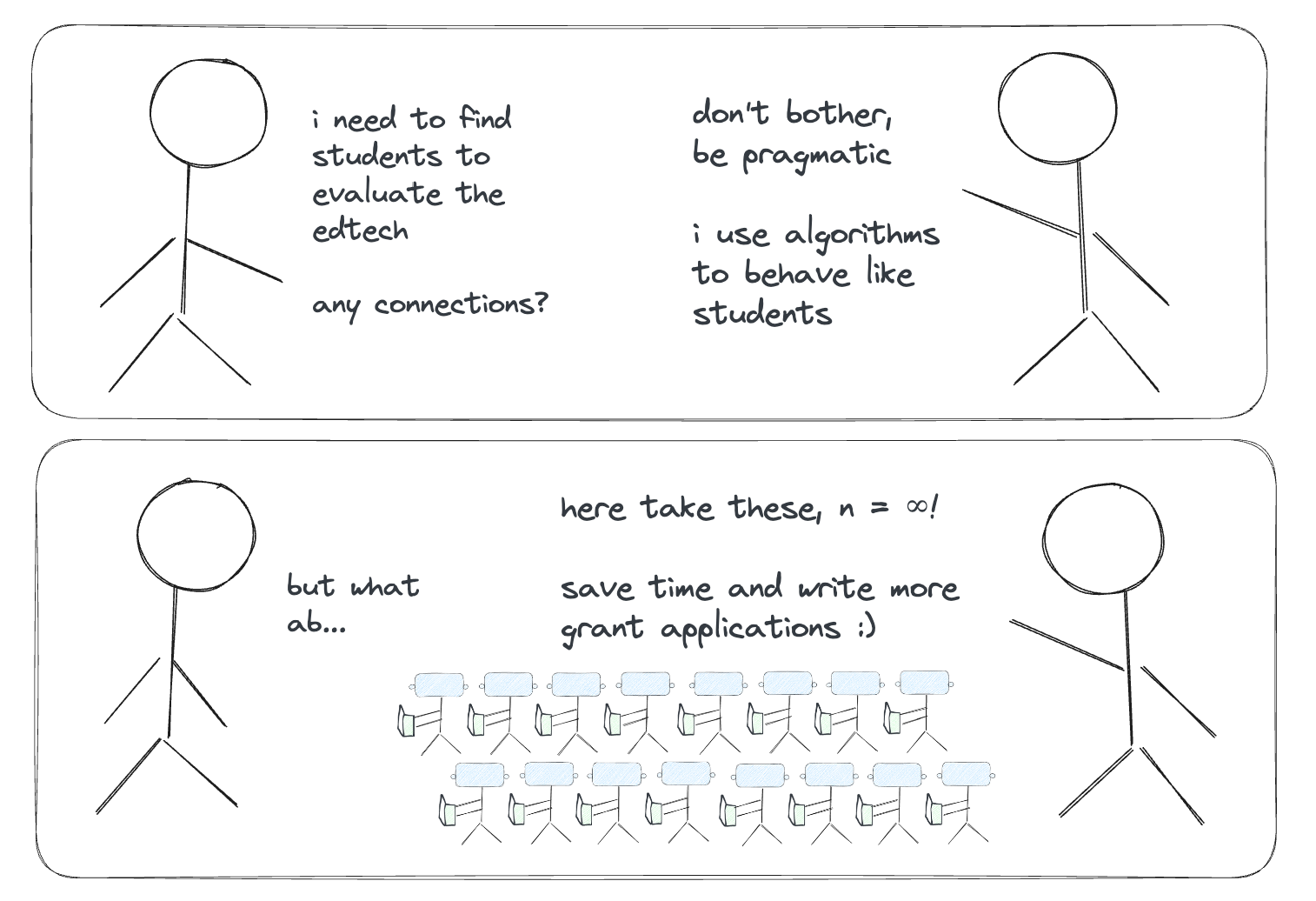
‘misinterpreting pragmatism, please don’t do this’ by me | [CC0](https://creativecommons.org/public-domain/cc0/)
#### The Nature of Education & Technology (Ontological Position)
Ontology is the nature of reality. It concerns how we view reality, which in turn impacts how we make sense of and investigate it. The following diagram presents different ontological perspectives on the classic problem of ‘glass half-full versus half-empty’.
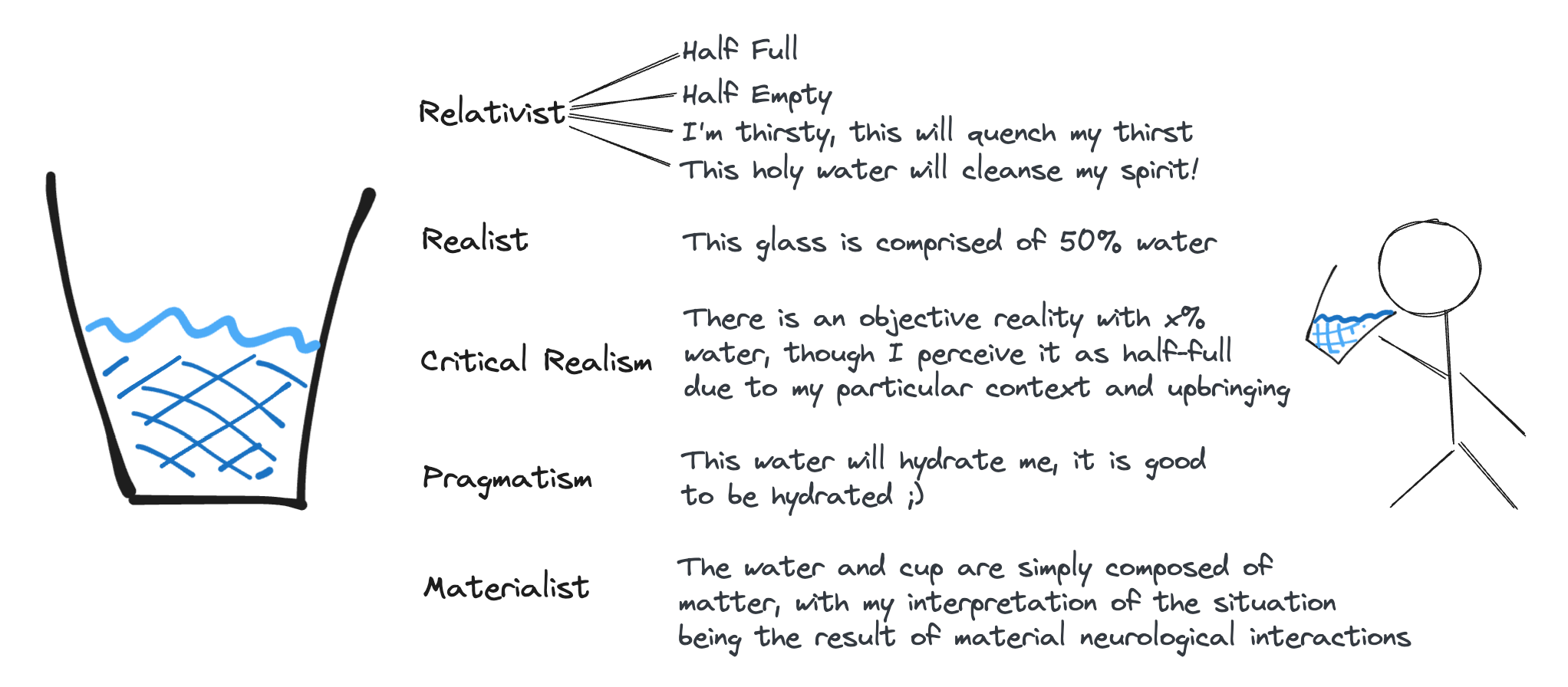
‘ontological perspectives of glass half-full versus half-empty’ by me | [CC0](https://creativecommons.org/public-domain/cc0/)
There is not a single correct ontological viewpoint; instead, it depends on the context being investigated. For instance, physics primarily adheres to ontological realism, focusing on a fixed reality independent of our observations. In contrast, anthropology often aligns with ontological relativism, where reality is considered relative to various perspectives and contexts.
Pragmatism stands out from other research paradigms by frequently embracing multiple ontological perspectives simultaneously — a concept known as ontological pluralism. This flexibility in acknowledging multiple realities helps us better navigate and represent the complex realities (Simmons, 2022) we often encounter in education and technology, which is inherently interdisciplinary and draws upon domains like education, computer science, social science, psychology, design science, and many more.
However, while the temptation may arise to choose many ontologies to represent a broad spectrum of domains, ontological pluralism itself introduces significant complexity for the researcher. Differing ontological perspectives are not simply additive; they have interdependent and conflicting natures (Turner, 2020), much like how different medications can interact and produce side effects. Therefore, the solution is not to maximise the variety and quantity of ontological perspectives, as conflicts among foundational beliefs can undermine the integrity and consistency of the entire research process.
Rather, the researcher should aim to balance the trade-off between complexity and the necessary representativeness of reality. To achieve this, researchers should understand the characteristics of different ontological perspectives, how these perspectives interact, which ones are suitable for various research areas, and more. I will elaborate.
- The notion of **reductionism** often carries negative connotations, but it can be a useful and necessary tool for **managing complexity**. For instance, when ontologies conflict excessively, simplifying by removing an ontology (which reduces the representativeness of reality) can improve ontological alignment and research feasibility. This pragmatic approach balances the trade-off between accurately representing reality and aligning ontologies for effective research execution. Even if research does not perfectly mirror the world, as long as it is guided by well-crafted questions targeting a novel research gap, it can still generate meaningful knowledge. However, researchers must be careful not to fall into the seductive trap of reductive thinking due to a reluctance to tackle complexity. Rather, reductionism should be a strategic decision.
- Similarly, we can also **narrow the scope of our research questions**. By targeting a more specific area, we can reduce reliance on multiple ontologies, making the research more feasible. This trade-off should be carefully evaluated in terms of impact and meaningfulness because well-grounded research that lacks meaningfulness remains ineffective.
- Just as a doctor has a deep understanding of the body’s systems and can anticipate how different medications interact, **researchers must develop expertise in how ontologies interact**. Understanding the affordances, negative implications, and interactions among different ontologies enables researchers to navigate trade-offs effectively, producing research that is both well-aligned and meaningful.
In “The Need for a Recovery of Philosophy,” Dewey states that “ideas are not mirrors which copy the objective world but tools with which we face and handle it” (1917). Building on this, I argue that under the pragmatic paradigm, the true nature of reality is secondary. Alignment between ontologies is irrelevant if research questions and studies do not yield tangible, meaningful results in the real world. From my experience, most questions worth answering in education and technology involve some degree of ontological conflict. Researchers who can navigate this conflict effectively will produce the most meaningful results.
#### Making Sense of Education & Technology (Epistemological Position)
Epistemology concerns the nature of knowledge, specifically how knowledge is acquired, validated, and justified. Essentially, it addresses the question, ‘How do we know what we know?’. There are many epistemological perspectives, including objectivism and subjectivism. However, pragmatists do not adhere to a notion of epistemological pluralism. Instead, they possess their own epistemology, which assesses the value of knowledge based on its utility in solving practical, real-world problems.
William James argued that truth is not absolute and does not require mathematical deduction from fixed axioms, empirical derivation through observation, or acceptance as absolute facts from a supreme being. This view contrasts with intellectualist and rational ideals that truth is a final end and represents an epistemologically stable equilibrium. Instead, James asked, **if** we “grant an idea or belief to be true” (1907, p. 77), **then** “what concrete difference will its being true make in anyone’s actual life?” (1907, p. 77). In this sense, knowledge is not viewed as art or as intrinsically meaningful but is rather assessed for its practical utility in the world. He even suggested that religion could be considered ‘true’ due to its practical utility (James, 1904), though this viewpoint was not shared by other pragmatist thinkers like Peirce (Shook, 2011).
While the pragmatic view on epistemology is varied and lies on a spectrum eg. James’s individualistic and Dewey’s social perspectives, the pragmatic epistemologies effect on the world is well aligned with the aims of education and technology — a domain that we do not research for answering larger theoretical questions, but rather to improve the practical realities for students on the ground, and thereby the wider society.
While the pragmatic perspective on epistemology varies and exists on a spectrum, such as James’s individualistic view and Dewey’s social approach, underlying is the notion that the pragmatic epistemology aims to produce meaningful impact in the world — which is central to the motivations for education and technology research, since this field is not researched to answer grand theoretical questions but to improve the practical realities for students and, in turn, broader society.
This pragmatic epistemology largely ties to Manuel Castells’s (2000) concept of “disposable theory” — recognising theory as an essential tool but also acknowledging that it should be discarded once it no longer serves to illuminate the substantive world. Amin and Thrift expand on this idea, arguing not for a generalisable theory capable of describing everything but that knowledge is contextually useful and adaptable as the world around us evolves.
> Theory has taken on a different style which has a lighter touch than of old. For a start, few now believe that one theory can cover the world (or save the world, for that matter). No particular theoretical approach, even in combination with others, can be used to gain a total grip on what’s going on. Theory-making is a hybrid assemblage of testable propositions and probable explanations derived from sensings of the world, the world’s persistent ways of talking back, and the effort of abstraction. (2005: 222)
In education and technology, this concept is significant because useful knowledge in education is often contextual and ever-changing. Thus, we should embrace this idea of ‘disposable theory’ and adopt an adaptable epistemology in pursuit of knowledge that brings meaningful value to society in a specific context and time.
Though, a core issue with pragmatic philosophy is the reliance on and uncertainty surrounding what is considered meaningful, as it is inherently a subjective phenomenon. Pragmatists who share the same ontological and epistemological foundations can still vary significantly in their research approach due to their axiological positions. This difference has been evident since the early days of pragmatism, as demonstrated by the divergent views of key figures such as Peirce, Dewey, and James (Moore, 1966). This dependence on underlying values can complicate collaborative interdisciplinary research (which as argued above is necessary for education and technology), making it challenging to coordinate efforts for social change. (Sokolova, 2013)
Another issue with pragmatic philosophy is the shift of responsibility onto the researcher. Instead of providing a predefined epistemology to follow, it demands that researchers determine which knowledge should be pursued, which theories are outdated, and what values should be prioritised in the current context and environment. While this shift in responsibility ensures that the epistemology remains relevant and informs research in the present and future, it also increases the effort and skill required to use it effectively. Therefore, if applied by a researcher with limited experience or inadequate consideration, it could yield negative outcomes.
Therefore, while the pragmatic epistemological position is adaptable and produces research with real-world value, it shifts responsibility (and, consequently, effort) onto the researcher to use it responsibly. Additionally, its implementation can vary depending on the values underpinning the research.
#### Subverting Ontology & Epistemology
However, within the pragmatic paradigm, ontology and epistemology are rarely addressed, with the focus often on axiology and methodology. This emphasis is criticised by researchers like Yvonne Lincoln, who note that “the mixed-methods pragmatists tell us nothing about their ontology or epistemology” (2010, p. 7). Nonetheless, axiology and methodology are central to pragmatism and are vital components of any meaningful discussion about pragmatism’s axiomatic bases.
#### Conclusion
In conclusion, pragmatism adheres to ontological pluralism, which better represents the multifaceted realities of the field but also adds complexity to the research process. Achieving a balanced trade-off involves applying reductionism, narrowing the scope of research questions, and developing expertise in ontological interactions. Pragmatism’s epistemology values knowledge based on its utility in addressing practical real-world problems and recognises that truth is not a final end but instead continuously evolves with time and changing contexts. However, there is subjectivity of what is considered meaningful and it increases the responsibility of the researcher. Overall, these qualities are well suited to generate more meaningful knowledge for education and technology. Still, it demands increased responsibility, effort, and expertise from the researcher.

‘too much coffee with philosophy’ by me | [CC0](https://creativecommons.org/public-domain/cc0/)
Here is a comic I made as part of axiology in the original essay, which was scrapped for brevity, enjoy :)
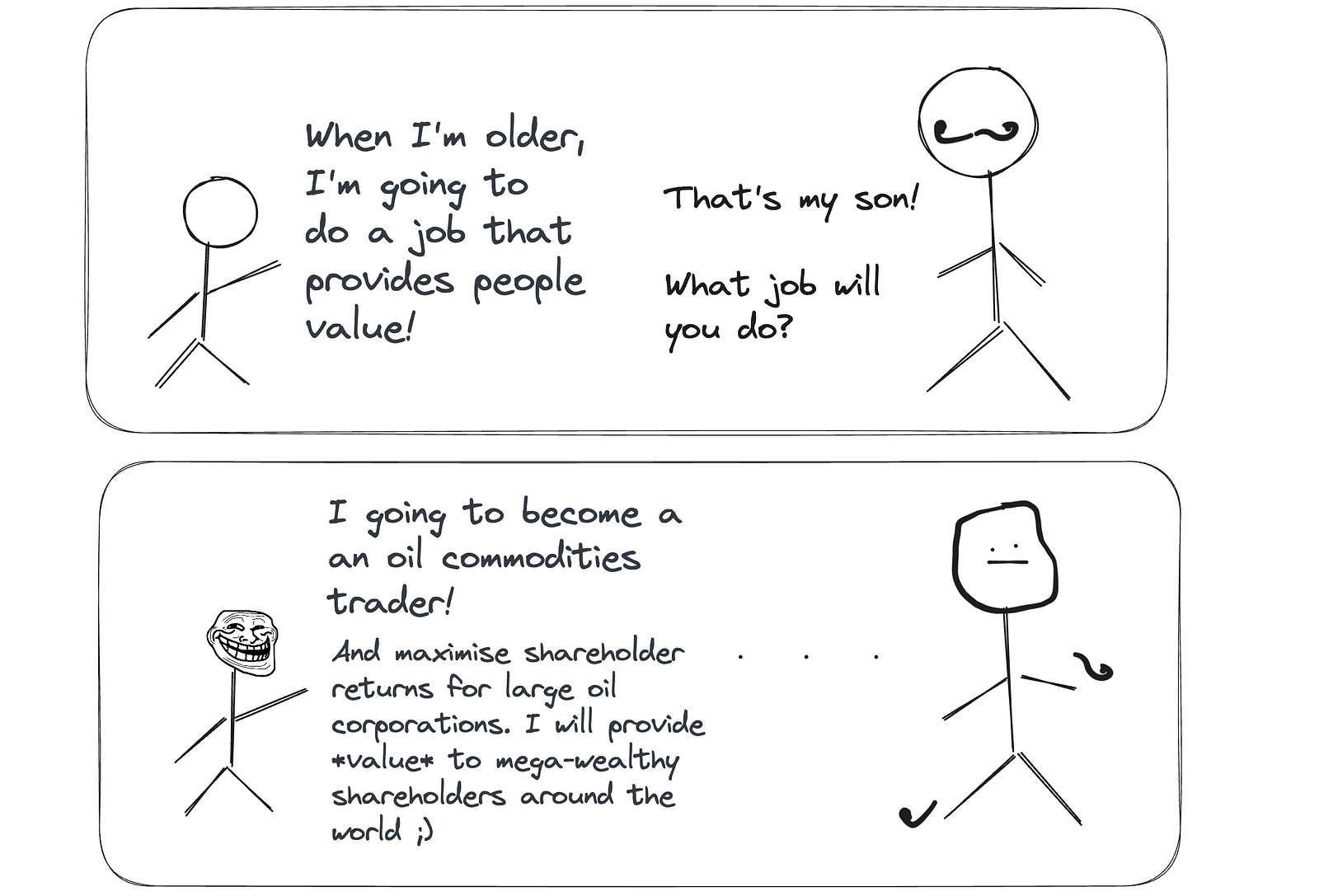
‘social value != shareholder value’ by me | [CC0](https://creativecommons.org/public-domain/cc0/)
_Hope you enjoyed reading! All my original content in this essay is dedicated to the public domain under_ [_CC0_](https://creativecommons.org/public-domain/cc0/)_._
#### References
Dewey, J. (1917). The need for a recovery of philosophy. In J. Dewey, A. W. Moore, H. C. Brown, G. H. Mead, B. H. Bode, H. W. Stuart, J. H. Tufts, & H. M. Kallen (Eds.), Creative intelligence: Essays in the pragmatic attitude (pp. 3–69). Henry Holt and Company.
James, W. (1907). Pragmatism’s conception of truth. In _Pragmatism: A new name for some old ways of thinking_ (pp. 76–91). Longman Green and Co.
Guba, E. G., & Lincoln, Y. S. (1982). Epistemological and methodological bases of naturalistic inquiry. _Ectj_, _30_(4), 233–252.
Peirce, C. S. (1905). What pragmatism is. _The Monist, 15_(2), 161–181. [https://doi.org/10.5840/monist190515230](https://doi.org/10.5840/monist190515230)
Turner, J. (2020). Ontological pluralism. In _The Routledge handbook of metametaphysics_ (pp. 184–195). Routledge.
Lincoln, Y. (2010). “What a long, strange trip it’s been…”: Twenty-five years of qualitative and new paradigm research. _Qualitative Inquiry, 16_(1), 3–9. [https://doi.org/10.1177/1077800409349754](https://doi.org/10.1177/1077800409349754)
Morgan, D. L. (2014). Pragmatism as a paradigm for social research. _Qualitative inquiry_, _20_(8), 1045–1053.
Deane, P. (2018, May 22). A guide for interdisciplinary researchers: Adding axiology alongside ontology and epistemology. i2Insights. [https://i2insights.org/2018/05/22/axiology-and-interdisciplinarity/](https://i2insights.org/2018/05/22/axiology-and-interdisciplinarity/)
Simmons, B. (2022). Ontological Pluralism and the Generic Conception of Being. _Erkenntnis_, _87_(3), 1275–1293.
Sokolova, T. (2013). Achieving integration in interdisciplinary research: Strategy or emergence? A case study of interdisciplinary research in Sweden. Master’s thesis, Department of Earth Sciences, Uppsala University. Uppsala University, Geotryckeriet.
James, W. (1904). The pragmatic method. _The Journal of Philosophy, Psychology and Scientific Methods_, _1_(25), 673–687.
Shook, J. R. (2011). PEIRCE’S PRAGMATIC THEOLOGY AND STOIC RELIGIOUS ETHICS 1. _Journal of religious ethics_, _39_(2), 344–363.
Moore, E. C. (1966). _American Pragmatism: Peirce, James, and Dewey_. Columbia University Press.